Tell us about the job
Takes about a minute. No obligation.
Sizing a heat pump for Boone County requires a contractor to take the local weather record seriously without letting it crowd out the fundamentals. 99 severe weather events were recorded in Boone County, Indiana between 2015 and 2024. That puts this area in the middle of the national range, which means severe weather is a genuine input to how a system is sized and how the refrigerant lines and electrical connections are run, but it does not excuse shortcuts on insulation, charge levels, or duct design. A contractor working here accounts for the weather load and still gets the install right on its own terms.
Ductwork designed for a gas furnace or a central air system of an earlier generation runs on different assumptions than a heat pump requires, and whether it can carry the new load without modification is the first thing a contractor has to settle. Half the homes in Boone County, Indiana were built in 1995 or earlier (2020-2024 ACS 5-year). That means a substantial share of the houses a contractor walks into here were ducted for something other than what is going in now, and the duct assessment shapes the quote before the equipment is ever priced.
What a Heat Pump System Includes and Where Each Piece Goes
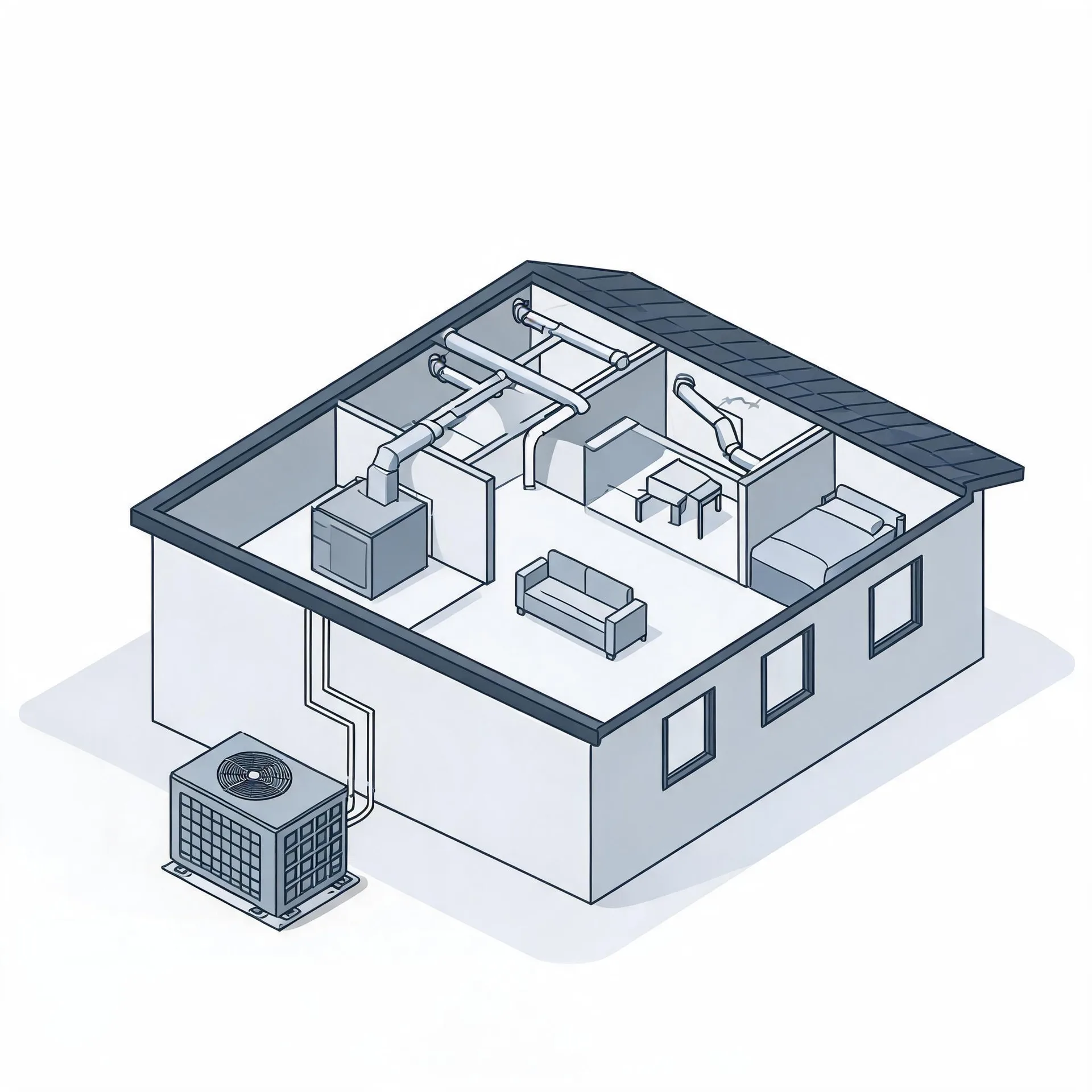
The outdoor unit sits on a pad beside the house and holds the compressor and the coil that pulls heat from outside air. Inside, the air handler mounts in a utility space, a closet, or an attic and moves conditioned air through the home. Together these two units do the core work of the system.
A refrigerant line set runs between the outdoor unit and the air handler, carrying the refrigerant that lets the two sides work together. A thermostat on an interior wall gives the homeowner control over the whole system, and a condensate drain line carries moisture away from the air handler to keep the space dry.
The drawing shows a typical layout, and a licensed contractor determines exactly how these pieces fit the construction and conditions of your specific home.
Find a contractor in Boone CountyBoone County, by the numbers
99 severe weather events were recorded in Boone County, Indiana between 2015 and 2024.
NOAA National Centers for Environmental Information, Storm Events Database, bulk CSV export, events 2015-01-01 through 2024-12-31.Half the homes in Boone County, Indiana were built in 1995 or earlier (2020-2024 ACS 5-year).
U.S. Census Bureau, 2020-2024 American Community Survey 5-Year EstimatesBoone County, Indiana holds 29,737 housing units (2020-2024 ACS 5-year).
U.S. Census Bureau, 2020-2024 American Community Survey 5-Year EstimatesOwners occupy 78.8% of the occupied homes in Boone County, Indiana (2020-2024 ACS 5-year).
U.S. Census Bureau, 2020-2024 American Community Survey 5-Year EstimatesSevere Weather Events in Boone County
Heating and cooling loads are shaped by what the weather actually does in a given place, not by regional averages. A heat pump sized and installed for local conditions handles demand better than one spec'd against a generic climate profile, which is why weather history in Boone County is a practical input to installation decisions here.
99 severe weather events, 2015–2024. Source: NOAA National Centers for Environmental Information, Storm Events Database.