Tell us about the job
Takes about a minute. No obligation.

A contractor quoting a heat pump repair in Jay County has to sort out what actually drove the failure before settling on a scope of work. 41 severe weather events were recorded in Jay County, Indiana between 2015 and 2024. At that rate, severe weather is an event in this county, not a standing condition, which means the refrigerant lines, the compressor, and the reversing valve are more likely worn by age and use than beaten down by weather load. If a contractor finds storm-related stress, it gets priced. More often they find a system that ran too long on a marginal install or went without service until something gave.
Much of the electrical and refrigerant infrastructure a contractor finds in Jay County homes was put in for equipment that predated the heat pump, then adapted over the years as systems changed. Half the homes in Jay County, Indiana were built in 1959 or earlier (2020-2024 ACS 5-year). That history matters on a repair call because what looks like a failed component sometimes traces back to undersized wiring or a line set that was never quite right for the load a heat pump draws. Opening the unit is only part of the job. A contractor also checks what feeds it.
The Parts of a Heat Pump a Contractor Checks During Repair
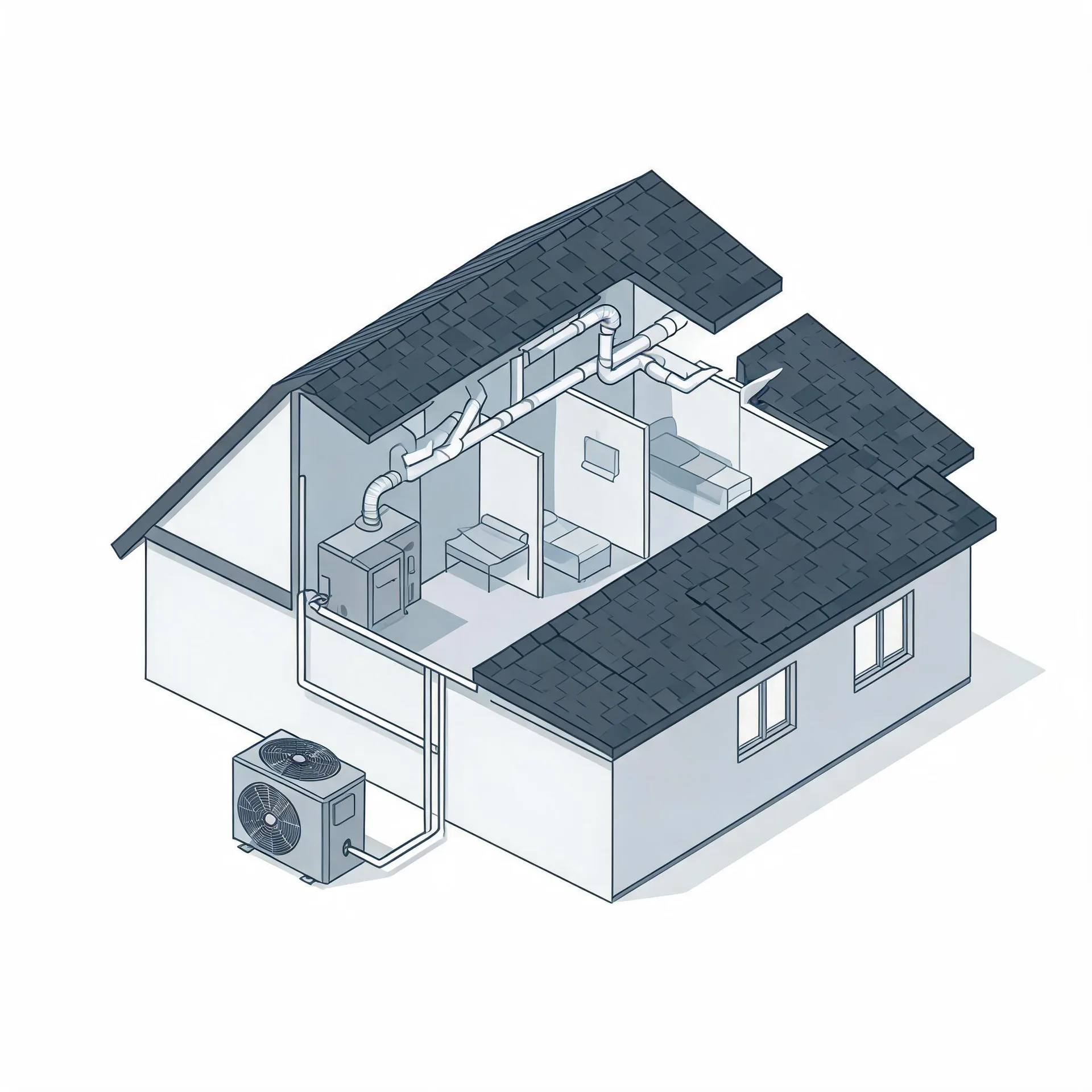
The outdoor unit is usually where a contractor starts. It sits on a pad beside the house and holds the compressor, which moves refrigerant through the system, and the outdoor coil, which transfers heat between the refrigerant and the air outside. A failed compressor or a damaged coil will stop the system from conditioning the air in any meaningful way.
Inside the house, the air handler contains the indoor coil and the blower fan, which pulls air across the coil and pushes it through the home. The expansion valve, refrigerant lines, and the reversing valve that lets the system shift between heating and cooling all sit between these two units and are points a contractor checks when the system is underperforming or running in the wrong mode.
The drawing shows the general layout of a heat pump system, and a licensed contractor will determine which components and conditions apply to your specific house.
Find a contractor in Jay CountyJay County by the numbers
41 severe weather events were recorded in Jay County, Indiana between 2015 and 2024.
NOAA National Centers for Environmental Information, Storm Events Database, bulk CSV export, events 2015-01-01 through 2024-12-31.Half the homes in Jay County, Indiana were built in 1959 or earlier (2020-2024 ACS 5-year).
U.S. Census Bureau, 2020-2024 American Community Survey 5-Year EstimatesJay County, Indiana holds 8,904 housing units (2020-2024 ACS 5-year).
U.S. Census Bureau, 2020-2024 American Community Survey 5-Year EstimatesOwners occupy 79.9% of the occupied homes in Jay County, Indiana (2020-2024 ACS 5-year).
U.S. Census Bureau, 2020-2024 American Community Survey 5-Year EstimatesSevere Weather Events in Jay County
Heat pumps in Jay County work against whatever the climate delivers, and that workload shapes how hard the equipment runs and how often it needs attention. What happens outside shows up, eventually, in the machinery inside.
41 severe weather events, 2015–2024. Source: NOAA National Centers for Environmental Information, Storm Events Database.